
From Waste to Biogas Resource: Mapping a Smarter Path for Farm and Food Waste in Ontario
An article by Ushnik Mukherjee (1), Nandita B. Basu (1,2) and Elanor Waslander (2)
(1) Department of Civil and Environmental Engineering, University of Waterloo, ON, Canada
(2) The Water Institute, University of Waterloo, Waterloo, Ontario, Canada
Every year, Ontario’s farms produce approximately 31.6 million tonnes of livestock manure, and the province generates a further 3.7 million tonnes of uncaptured food waste. Manure is an essential nutrient resource for agriculture, but when produced in excess or concentrated in livestock-dense regions, managing it becomes increasingly difficult. At the same time, food waste piles up in landfills, releasing greenhouse gases into the atmosphere. What if we could turn both problems of livestock manure and excess food waste into a solution?
Stored and land-applied manure releases methane and nitrous oxide, greenhouse gases with roughly 27 and 273 times the warming potential of carbon dioxide. Manure management alone was responsible for about 7.8 Mt of CO2-equivalent emissions in Canada in 2022, and agriculture accounts for 29% of national methane emissions and 78% of nitrous oxide. Landfilled food waste adds to another significant methane source, since landfills contribute around 16% of Canada’s total methane emissions.
There is also a water-quality side to the story. When manure is applied year after year in livestock-dense regions, phosphorus and nitrogen accumulate beyond what crops can use. The surplus runs off and leaches into surface waters, fuelling the harmful algal blooms and eutrophication that have long affected freshwater systems across southwestern Ontario.
The encouraging news is that an alternative already exists. Through anaerobic digestion, microbes break down organic material such as manure and food scraps in the absence of oxygen. This produces biogas, which can be upgraded into renewable natural gas (RNG) and injected into existing pipeline networks. The process also creates digestate, a nutrient-rich byproduct that can substitute for synthetic fertilizers on farms.
Anaerobic digestion has been technically viable for decades, but its widespread deployment is constrained by economics. Manure contains relatively little recoverable energy per tonne because it is wet and dilute. Typical cattle or pig manure yields roughly 19 to 25 cubic metres of methane per tonne. Farm-scale systems often require 10,000 to 40,000 tonnes of feedstock per year to be financially viable, a scale many livestock operations in Ontario do not reach individually. Wet manure is also expensive to haul, limiting transport for land application.
One way forward is to think bigger and more strategically. Instead of relying only on individual farm digesters, centralized facilities could draw manure from multiple farms and combine it with food waste from nearby towns and cities. Co-digesting manure with energy-dense food waste increases gas yields, larger plants benefit from economies of scale, and siting facilities near existing natural gas pipelines lowers the cost of delivering RNG to market. But these advantages come with trade-offs, including longer hauling distances, higher capital costs, and new infrastructure needs. The practical question is how to weigh these factors together, and where, exactly, to build.
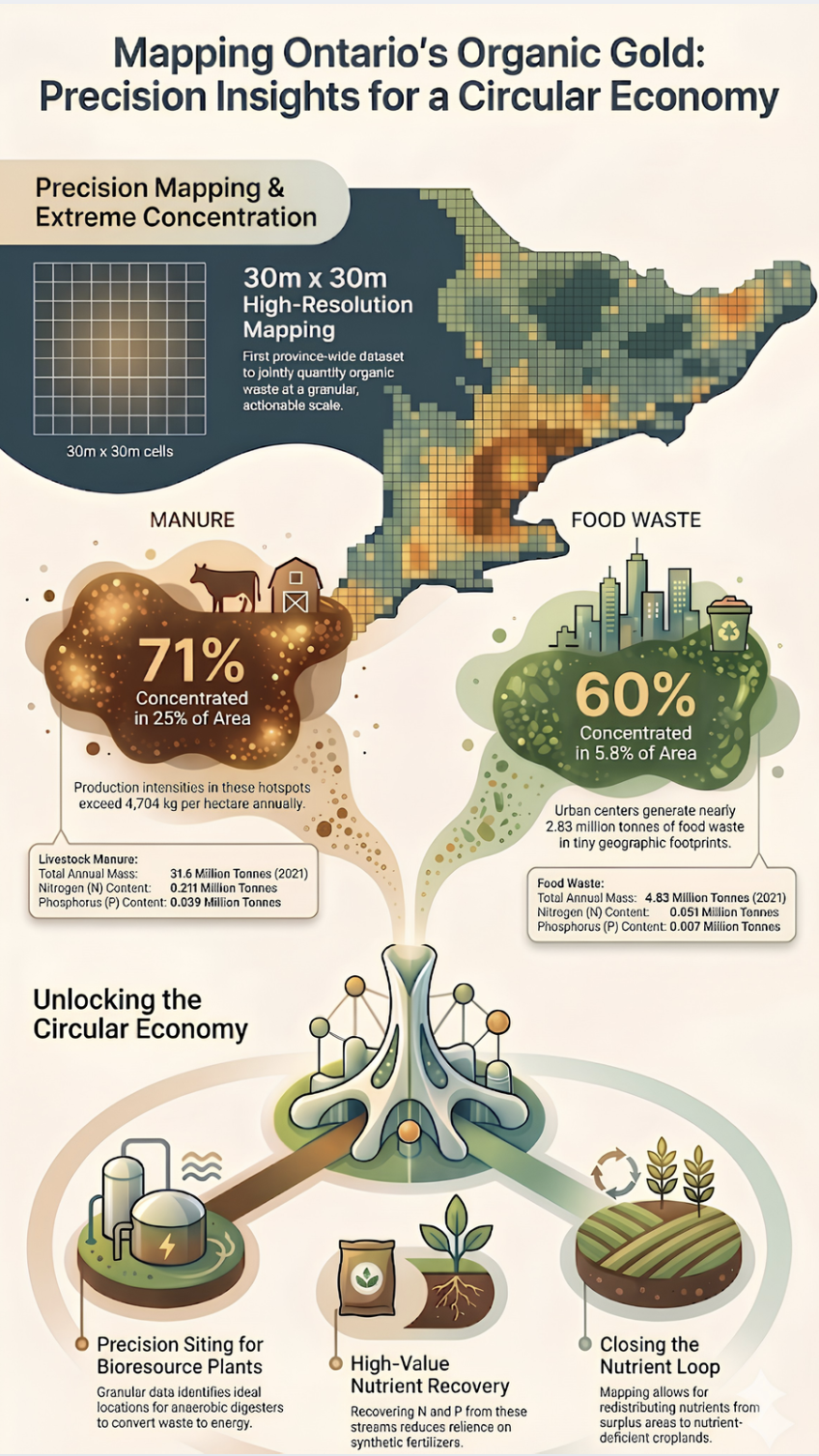
Caption: Ontario’s manure and food waste are highly concentrated: 71% of manure sits in just 25% of the province, and 60% of food waste sits in under 6%. This spatial unevenness is what makes targeted infrastructure planning possible. (Created with NotebookLM)
A Smarter Planning Model for Ontario
This is the challenge taken on through SOLUTIONSCAPES, a broader University of Waterloo research initiative focused on designing landscape-scale solutions for interconnected climate, water, food, and energy challenges. Led by Professor Nandita Basu and Dr. Ushnik Mukherjee and involving a multidisciplinary team of researchers, trainees, and collaborators, the initiative explores how better spatial intelligence can guide more effective environmental investments.
Their research asks not just how much bioenergy Ontario could theoretically produce, but the harder and more practical questions: where should digesters be located, how large should they be, and how should manure and food waste move across the landscape to reach them?
To answer these questions, the team developed SYNERGI (SYstemic Nutrient and Energy Recovery through Geo-Informed Integration), a high-resolution spatial planning framework that treats renewable natural gas development as an infrastructure design problem rather than a simple feedstock accounting exercise.
The first step was building a fine-scale provincial dataset integrating:
manure availability from agricultural census data and mapped livestock operations
food waste generation from residential and industrial, commercial, and institutional sources
Ontario road networks to estimate transport distances and costs
proximity to natural gas pipelines
crop nutrient demand, indicating where digestate can be productively used as fertilizer
Using these layers, the model identifies digester locations, facility sizes, and feedstock flows that minimize total system cost under different energy-production targets. It can compare decentralized farm-scale systems with larger centralized hubs, and evaluate how costs and benefits change as deployment expands.
Why It Matters
This kind of framework allows policy to move beyond blanket subsidies toward targeted deployment. Instead of rewarding any project that produces biogas, incentives can prioritize the sites and configurations that deliver the greatest combined public value.
That includes:
climate benefits by avoiding methane emissions and displacing fossil natural gas
waste diversion by redirecting food waste from landfill
renewable energy supply through existing pipeline infrastructure
water-quality gains by redistributing nutrients away from livestock-dense hotspots where they exceed crop demand
Experience elsewhere shows why this matters. In parts of the United States, generous renewable fuel credits have accelerated digester construction, particularly in California’s dairy sector. While this has increased methane capture, critics have noted that uniform subsidies can reward whichever projects are easiest to build rather than those delivering the greatest environmental benefit. Ontario has an opportunity to build smarter incentives from the start.
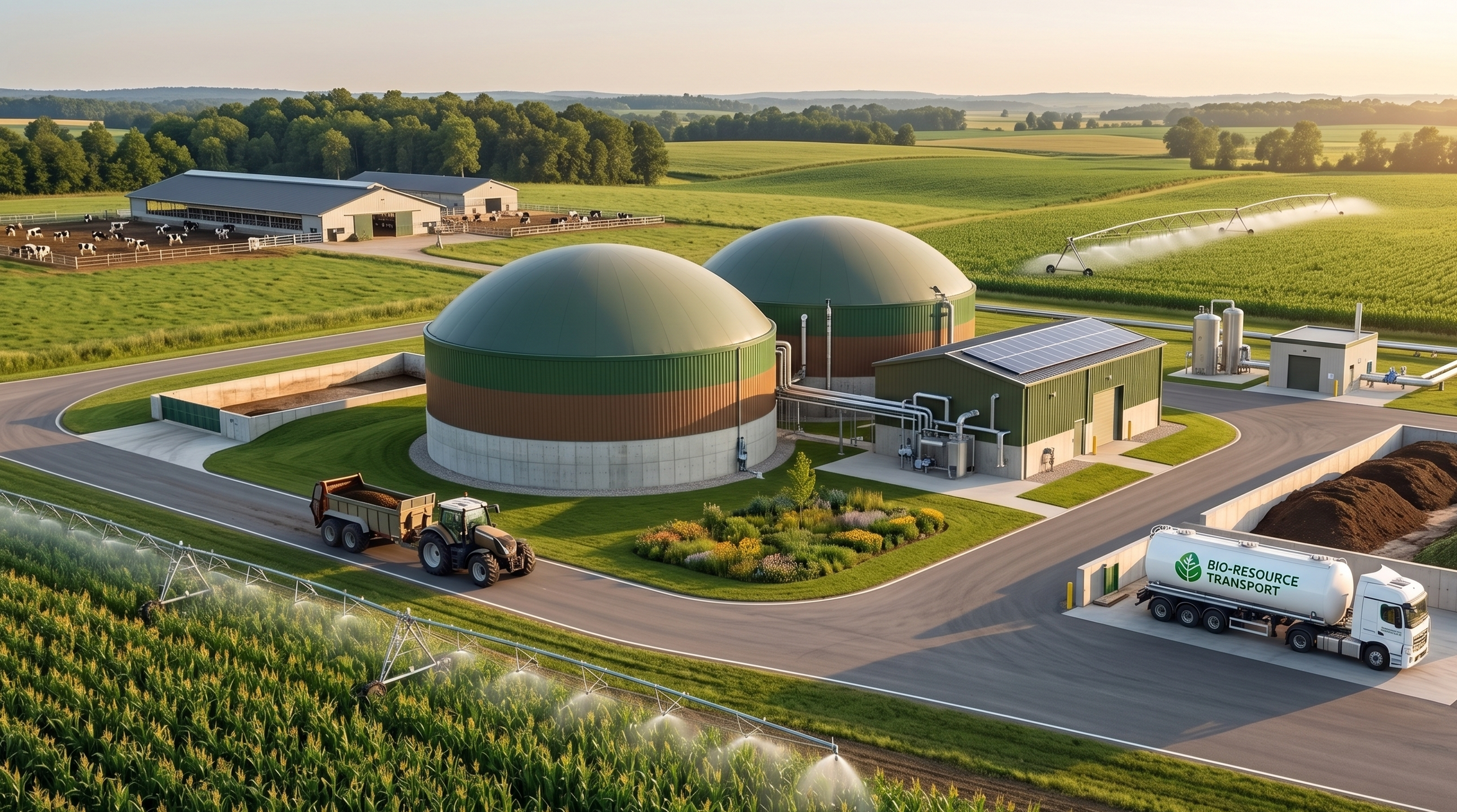
Caption: A modern, centralized anaerobic digester facility optimally placed to serve surrounding agricultural and urban areas. (Image generated with AI)
The Bigger Lesson
The clean energy transition requires not only new technologies, but better spatial intelligence. For waste-to-energy systems like anaerobic digestion, the technology already exists. The harder challenge is knowing where resources are generated, where infrastructure should be built, and how materials should move between them.
Without that intelligence, even generous subsidies risk producing facilities in the wrong places. With it, Ontario has an opportunity to turn manure and food waste into clean energy, recycled nutrients, and smarter environmental progress.
A recent presentation to Agriculture and Agri-Food Canada (AAFC) was an opportunity to bring this evidence into active federal conversations about food waste diversion and on-farm digester investment. The full paper detailing the SYNERGI framework is currently under review.
Acknowledgements
This research was supported by funding from SOLUTIONSCAPES: Designing Climate and Water Smart Agricultural Solutions in Complex Working Landscapes (Project No.: EDF-CA-2021i017), funded by Environment and Climate Change Canada. The authors gratefully acknowledge the Agricultural Renewable Natural Gas (RNG) Resource Clustering Study for the original framework that informed this work, particularly the barn-identification methodology and preliminary data on identified barns upon which portions of the approach were built. The authors would also like to thank Kirsten Hoekstra, Bibiana Egbunike, and Finan Turnage-Barney for their valuable contributions to the development and verification of livestock barn identification and food waste data collection. Their efforts were instrumental in assembling the high-resolution spatial dataset that underpins this work.

Personal note
Ushnik Mukherjee is a Research Associate in the Department of Civil and Environmental Engineering at the University of Waterloo, working with Professor Nandita Basu's research group.
His work integrates spatial data, optimization, and systems analysis to inform the design of bioenergy and nutrient-recovery infrastructure, supporting evidence-based decision-making at the intersection of food, energy, and water resources.