
Exploring Ontario’s Sludge Opportunities and Challenges
An article by Camila Granito Gimenes
Where does your waste go?
Wondering where our waste goes, is a question most of us never ask. We flush the toilet, and the waste disappears. We assume the "water" gets cleaned (and it does!) but have you ever stopped to wonder what happens to the solids which stay behind? This question shaped much of the recent research conducted by Camila Granito Gimenes, a Research Associate in Civil and Environmental Engineering and a member of Solutionscapes at the University of Waterloo.
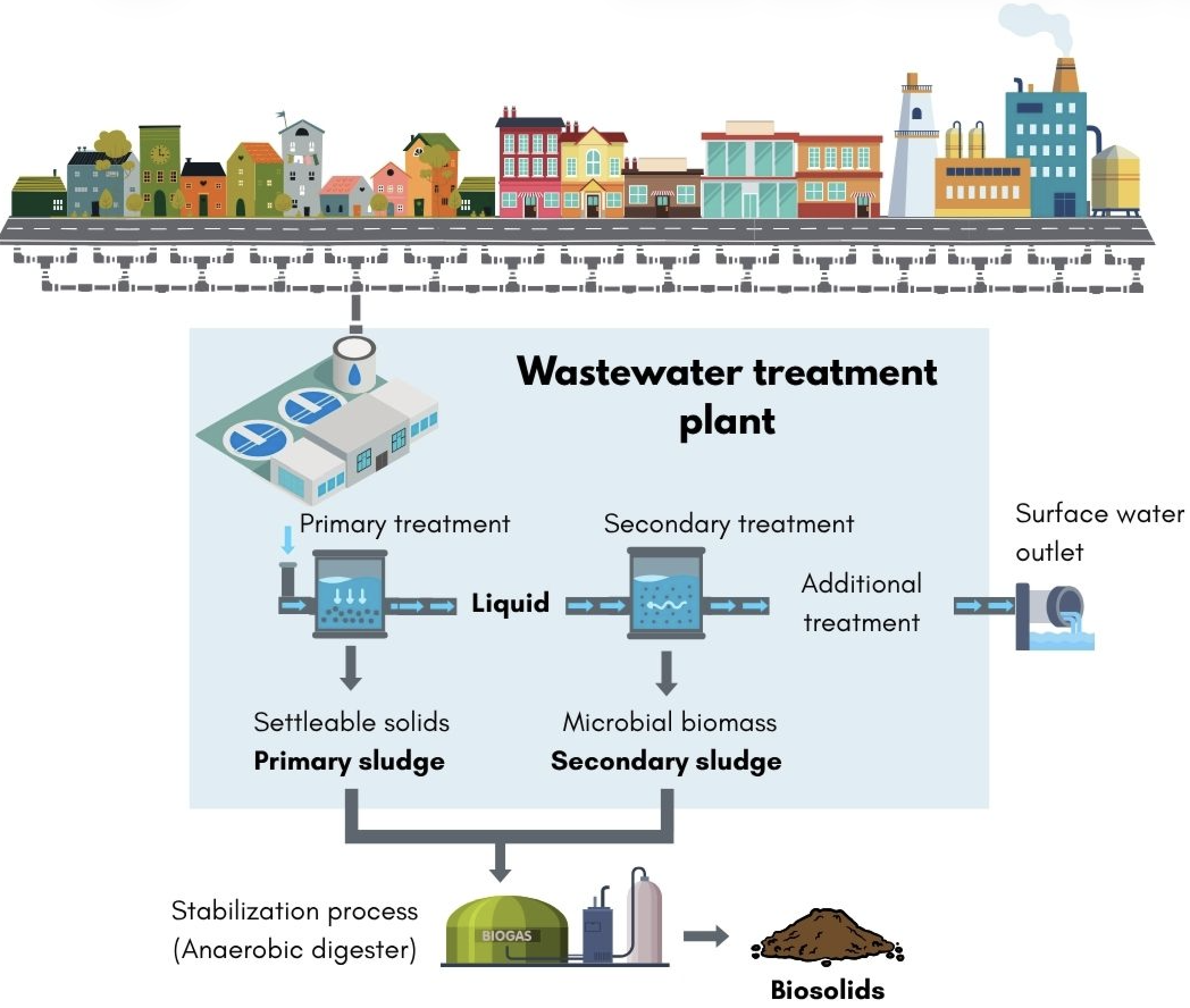
Caption: Simplified municipal wastewater sludge generation process (designed in Canva).
The Provincial Blind Spot
Tracking every tonne of waste material, known as sewage sludge, across a province as vast as Ontario is a monumental task. When Gimenes set out to study Ontario’s wastewater for her Master's thesis, she discovered just how decentralized this information was. Gimenes uncovered that a comprehensive dataset of sludge generation did not exist.
In partnership with the Ontario Clean Water Agency (OCWA) and founded by the Ministry of the Environment, Conservation and Parks (MECP), Gimenes utilized federal datasets encompassing a comprehensive list of 548 municipal wastewater treatment plants across the province. These datasets identified how much water flowed through each plant and which specific treatment and stabilization processes they used. However, to paint a complete picture, Gimenes still needed to answer a critical question: exactly how much sludge was each plant generating, and where was it ultimately going?
Filling the Gaps
Answering that question proved challenging precisely because the information does not exist in one place or sometimes at all. Data on sludge generation is often scattered across jurisdictions, reported inconsistently, or embedded in municipal documents intended for other purposes. Even when information is publicly available, it can vary widely in detail, terminology, and context, making comparisons difficult.
Overcoming these gaps required the careful interpretation of local treatment practices, reporting standards, and operational realities. Ultimately, this fragmented reporting is not the result of neglect, but of a system designed to manage waste efficiently at local level rather than track it comprehensively on a provincial scale.
What the Flush Leaves Behind
Despite these hurdles, bringing these pieces of data together created a complete picture of wastewater solids, revealing patterns that are usually hidden from view. A primary goal of this research is to understand how sludge generation is distributed across the province and how different types of treatment systems contribute to the overall picture.
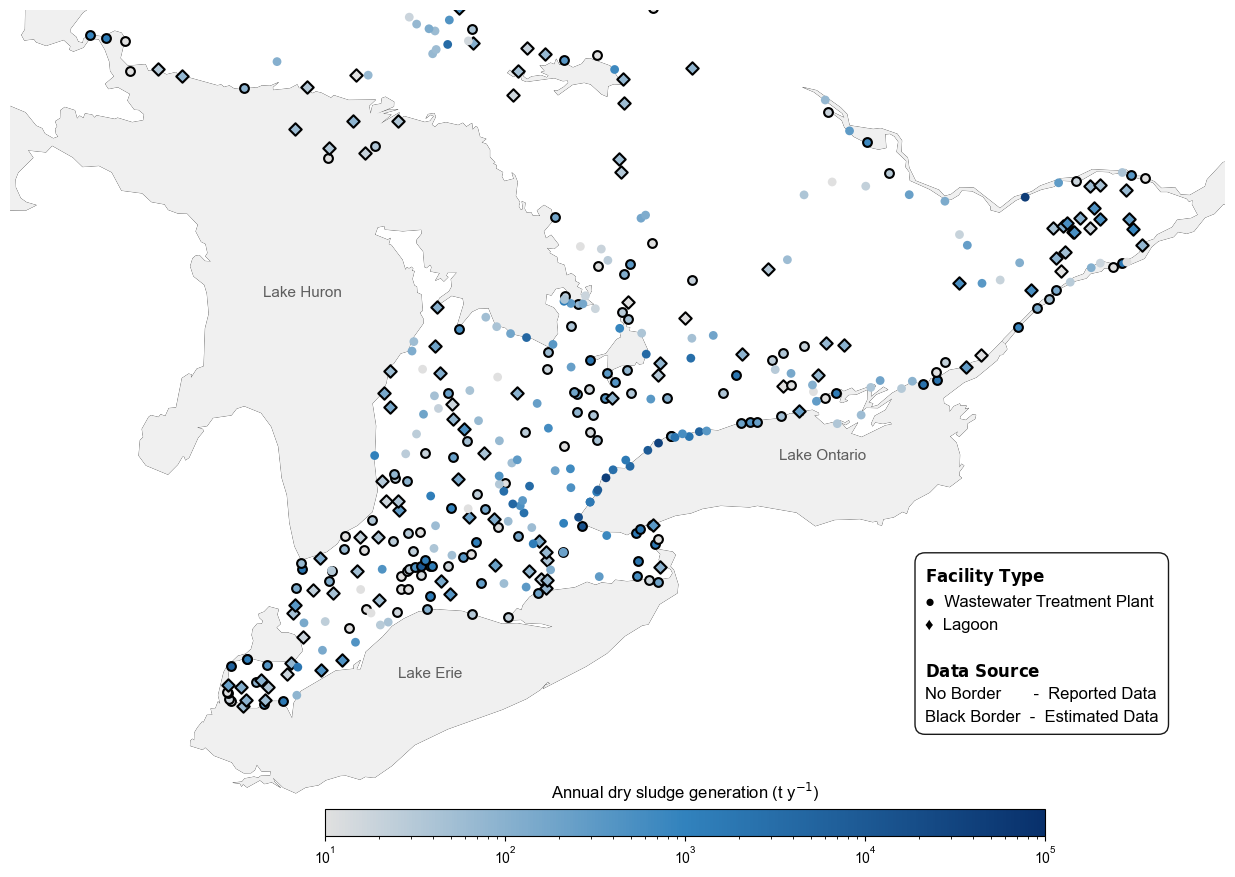
Caption: Spatial distribution of dry sewage sludge generation across Ontario by facility type and data source.
Early insights suggest that a small number of large facilities may play an outsized role in sludge production, while a much larger number of smaller, often rural systems operate with limited visibility. These smaller systems, often lagoon-based, frequently store sludge passively over long periods, making it difficult to track quantities or plan for responsible management. Recognizing these dynamics could be an important step for Ontario, offering opportunities to improve long‑term planning, reduce unexpected logistical bottlenecks, and support more consistent management practices across diverse communities.
The Utilization Challenges
Whether managed by a large urban plant or a small rural lagoon, the ultimate fate of this sludge presents both a significant challenge and a missed opportunity. Sewage sludge represents a largely untapped resource with the potential to support more sustainable nutrient cycles. When appropriately treated and verified to meet environmental standards, it can be transformed into “biosolids” that safely return vital nutrients like phosphorus and nitrogen to the land, reducing reliance on synthetic fertilizers and closing important material loops.
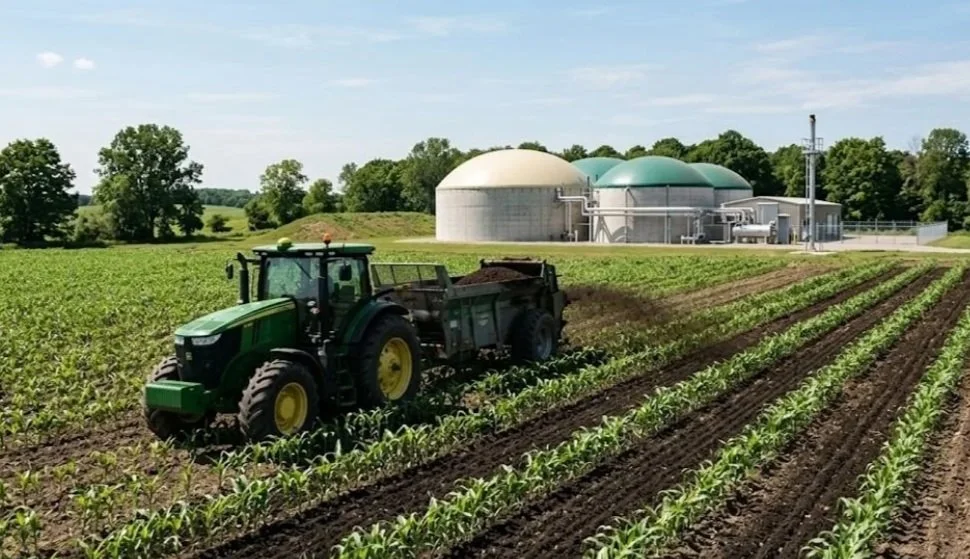
Caption: Stabilized biosolids applied on land. (Image generated with AI)
In practice, however, realizing this potential remains difficult. The recovery and reuse of biosolids can be constrained by logistical, regulatory, and infrastructural challenges. For example, seasonal weather limitations and stringent agricultural requirements often necessitate long‑term storage, which many facilities are not equipped to provide. As a result, some large wastewater systems that process high volumes of sludge year-round depend on disposal pathways that prioritize immediate volume reduction over resource recovery, like incineration. These approaches can permanently remove valuable nutrients from circulation, limiting future reuse.
From Waste to Resource
To transition toward a circular economy, Ontario can turn these challenges into actionable opportunities. Rather than relying on practices that permanently destroy valuable nutrients, the province can explore alternative management strategies designed to capture and reuse this material safely and effectively.
Waste management is the foundation of a healthy province, and understanding the data is the first step toward making informed decisions. By integrating rigorous data tracking with targeted investments, Ontario can stop treating sludge as a burden and start utilizing it as a valuable resource.
Acknowledgements
This research contributes to the SOLUTIONSCAPES project and supported by the Ministry of the Environment, Conservation and Parks (MECP) and Ontario Clean Water Agency (OCWA). Special thanks to supervisors Dr. Nandita Basu, Dr. Ushnik Mukherjee, Indra Maharjan and the late Aaron Law.

Personal note
Camila Granito Gimenes is a Master’s graduate in Civil Engineering (Collaborative Water Program) from the University of Waterloo and currently serves as a Research Assistant in Nandita Basu’s group.
Her research focuses on water systems analysis, contributing to improved understanding and management of watershed processes and supporting informed environmental decision-making.