
From Emissions to Storage: Understanding the Whole Wetland Carbon Budget
An article by Jordan Li
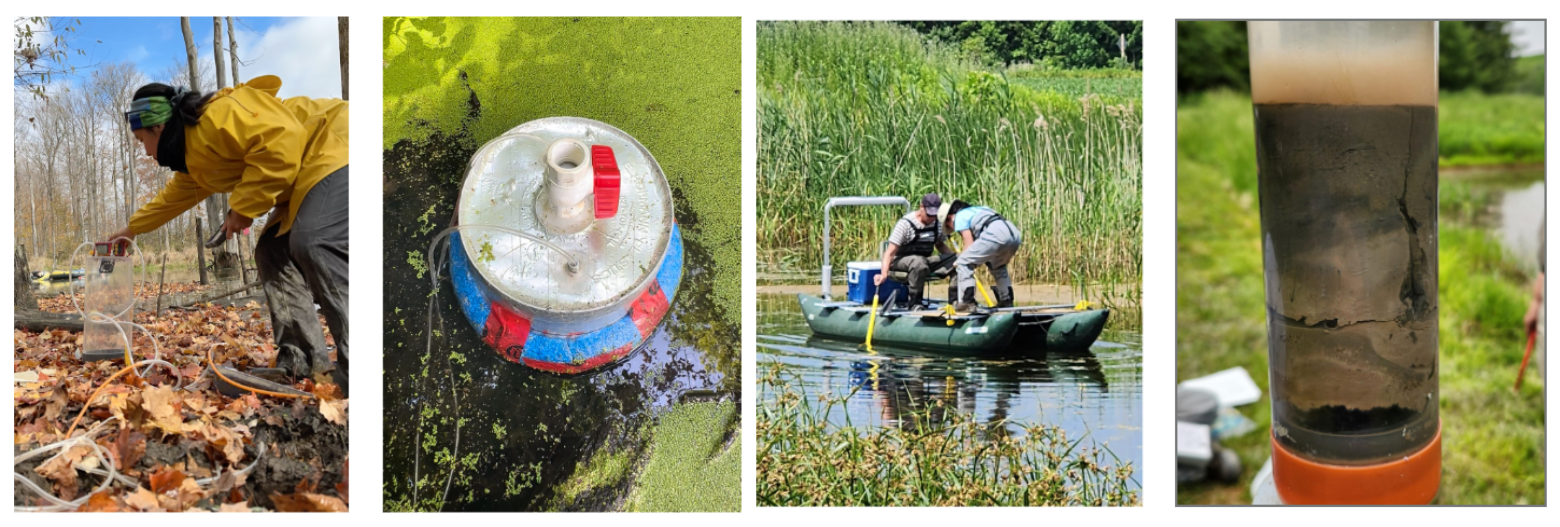
Caption: Collecting GHG estimates from the “dry zone” (left), and collecting sediment for carbon storage estimates (right).
As Canada looks for practical, cost-effective ways to reduce emissions and adapt to climate change, wetlands are increasingly promoted as powerful nature-based climate solutions. But restoring and protecting wetlands is not automatically climate-positive. To make good decisions, governments and practitioners need clear, complete evidence about how wetlands store carbon, and when they release it.
From wetlands to farmland to cities
Wetlands were once widespread across what we now know as Southern Ontario, forming a rich and interconnected “wetland complex”. Colonial settlement and the conversion of land for agriculture, driven by the region’s fertile soils, transformed Southern Ontario into Canada’s “agricultural powerhouse”. Over time, population growth and broader land-use demands have led to the loss of approximately 70% of Southern Ontario’s original wetlands.
Wetlands act as natural water filters for farmlands. As water moves through wetlands, nutrients and biological matter are captured by plants and stored in soil, reducing the amount of pollution that reaches downstream water bodies such as Lake Erie, which has historically struggled with harmful algal blooms driven by nutrient runoff.
The carbon trade-off in wetland restoration
Wetlands that have existed for over a century store large amounts of carbon in their soil and plants, but when wetlands are restored, they can initially release greenhouse gases such as methane and carbon dioxide. This creates an important trade-off: short-term emissions versus long-term carbon storage. Understanding which wetland features and environmental conditions drive emissions is critical if wetlands are to deliver real climate benefits.
What current research often misses
Many studies focus on either carbon storage or greenhouse gas emissions, but rarely assess both together as a full “carbon budget,” especially in Southwestern Ontario. Even fewer studies measure what happens at the edges of wetlands, where water levels fluctuate, creating hotspots for greenhouse gas emissions. Excluding these transition areas can lead to incomplete or misleading estimates of how much carbon wetlands store or release.
Our approach: Measuring emissions from the center to the edges
Our research aims to give a complete assessment of carbon in wetlands, measuring both:
greenhouse gas emissions released after restoration from the transition edge zone to the center, and
long-term sediment carbon storage that wetlands provide.
We take measurements from both open water areas and the surrounding wetland edges, where water levels rise and fall, and emissions may increase (see diagram of method). Including the edges ensures we capture emissions from the entire wetland system, not just the center.
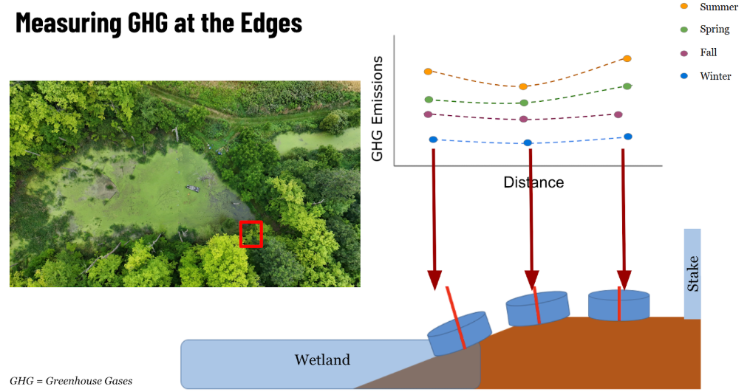
Caption: Diagram of methods. The graph does not represent real data.
We also collected sediment cores and analyzed them to measure how much carbon is stored in the soil over time. Together, these measurements allow us to develop a complete “carbon budget” showing both what wetlands release and store.
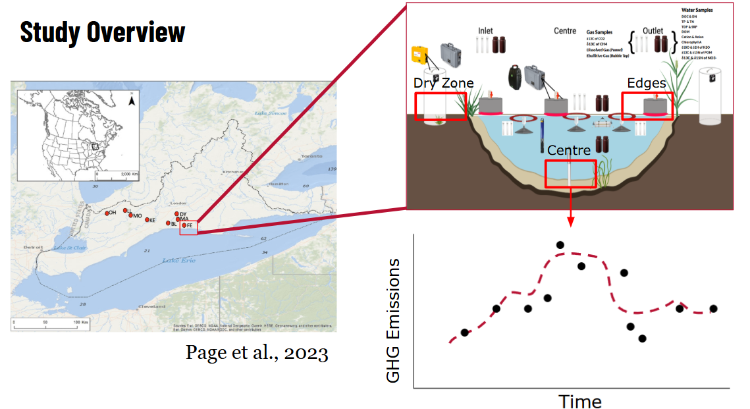
Caption: Study overview in Southern Ontario. Data is not representative of real data.
Why landowners are essential partners
Measurements alone do not tell the full story of wetland function. To understand how wetlands operate in the context of the people who care for them, talking with landowners helps us see how land use, management, and daily decisions influence wetland health. These conversations add context that links the science of carbon with the experiences and insights of the people living and working on the land.
Half of the landowners that we worked with shared insights into local knowledge that we would not have been able to gather from data alone, helping explain the changes we observed. Together, these exchanges highlight the importance of collaborative research, where scientific data and landowner knowledge work together to support more effective application of sustainable land management practices.
From evidence to action
To fully understand how wetlands function as nature-based climate solutions, we must consider the whole system. By leveraging research–landowner partnerships, we can gain insights about the land that formal scientific methods alone cannot provide.
Effective application of this research requires engaging not only landowners and conservation organizations, but also policymakers who shape funding programs, restoration priorities, and climate accounting frameworks. By integrating rigorous science with lived experience, wetlands can be managed in ways that are both climate-smart and grounded in real-world context.
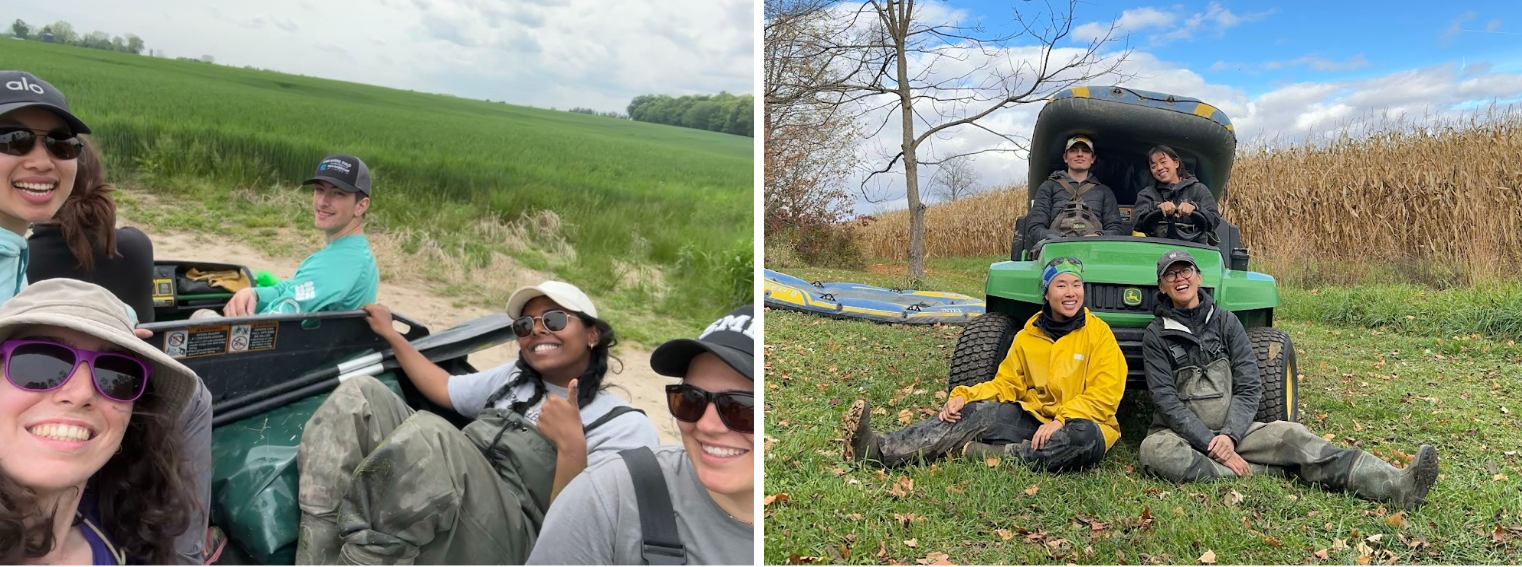
Caption: Field season researchers involved in the intensive sampling for this year’s field campaigns. From left to right in the left-hand image: Jordan Li, Sara Abate, Joey Ruck, Thenuja Vittanachchi, and Emily Vesnaver. Not pictured: Ruby Collins. From front to back in the right image: Jordan Li, Jennifer Zhou, Caden Hutcheon, and Natalie Liu.
Acknowledgements
This research contributes to the SOLUTIONSCAPES project and is funded by a Natural Sciences and Engineering Research Council of Canada (NSERC)Alliance and Mitacs grant ('Designing Climate and Water Smart Wetland Restoration Scenarios for Canada's Agricultural Landscapes') with Pl Nandita Basu, co-Pl Tonya DelSontro and collaborators Pascal Badiou and Bryan Page from Ducks Unlimited Canada, and Chris Parsons from Environment and Climate Change Canada.

Personal note
Jordan Li is a Master of Earth Science student (Collaborative Water Program) at the University of Waterloo and holds a Bachelor’s degree in Earth Science from the same institution. Their undergraduate co-op work also examined greenhouse gas emissions and carbon storage in the wetlands featured in this study.
Jordan’s research applies a whole-system approach to wetland carbon dynamics, integrating emissions and long-term storage to support evidence-based wetland restoration and climate policy. The work has been rewarding as it also incorporates landowner perspectives, strengthening the real-world relevance of the findings for wetland management and implementation.